Call anytime


-
-
Send email
polagressgranito@gmail.com
Call anytime
Send email
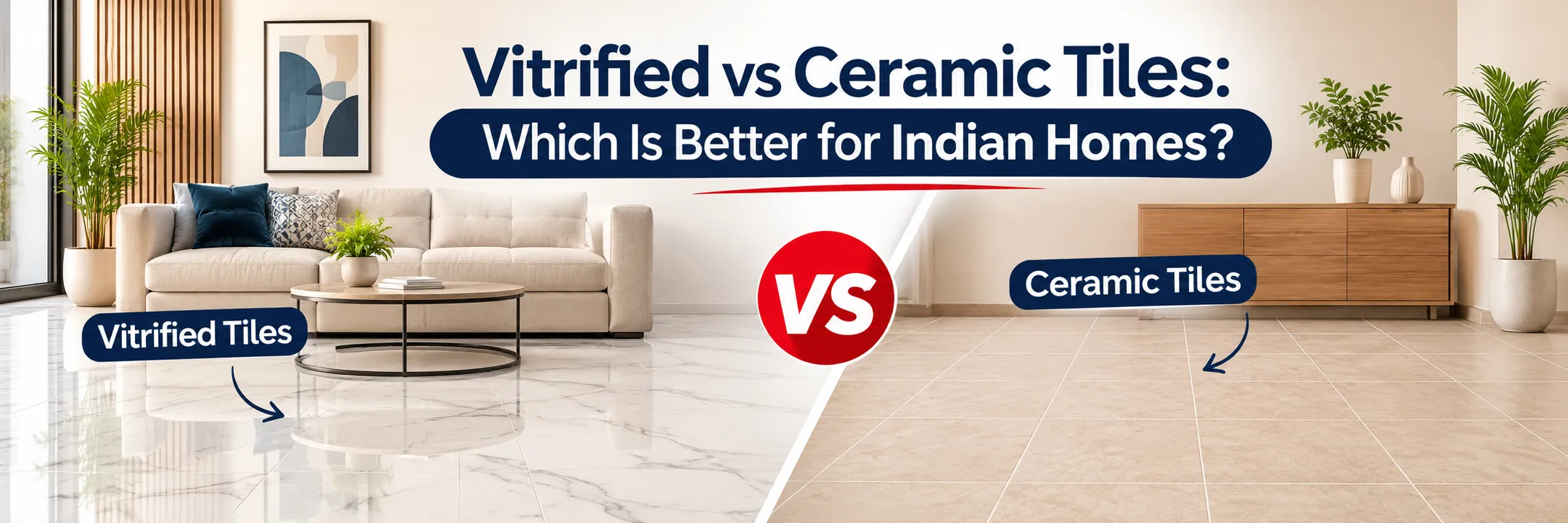
Standing in a tile showroom, every sample looks perfect. The real question comes later, when monsoon damp, hard-water stains and daily footfall test your choice. Vitrified vs ceramic tiles is the decision many Indian homeowners struggle with, because both look good but behave differently on floors, walls and wet areas. This guide compares strength, water absorption, cost, maintenance and room-wise use, so homeowners, builders and dealers can pick the right tile for each room and avoid costly mistakes after installation.
Vitrified tiles are made from clay mixed with silica, quartz and feldspar, then fired at very high temperature until the body becomes dense and glass-like. This gives very low water absorption and a hard surface. Common types include GVT, PGVT, double charge, full body and digital vitrified tiles.
Ceramic tiles are clay-based tiles that are shaped, glazed and fired at lower temperatures. They are more porous and widely used as wall tiles and light-use floor tiles.
Vitrified vs ceramic tiles comes down to durability, water resistance and budget. Exact figures vary by brand and product, so always read the spec sheet.
|
Factor |
Vitrified tiles |
Ceramic tiles |
|
Water absorption |
Very low |
Higher |
|
Strength and wear |
High, suits heavy traffic |
Moderate, suits light to medium traffic |
|
Stain and scratch resistance |
Better |
Glaze can chip or wear over time |
|
Cost |
Usually higher |
Usually lower |
|
Cutting and fitting |
Harder, needs a skilled fitter |
Easier to cut and fit |
|
Design range |
Marble, wood and stone looks |
Wide range, especially for walls |
|
Best for |
Floors and high-traffic areas |
Walls, bathrooms and light-use floors |
Living room and bedroom floors: vitrified for durability, including large formats such as 1200×1800 mm slabs.
Kitchen floor: matt or anti-skid vitrified. Kitchen wall and backsplash: ceramic, which is easy to wipe clean.
Bathroom walls: ceramic. Bathroom floor: anti-skid ceramic or matt vitrified.
Balcony and terrace: anti-skid, outdoor-rated vitrified tiles.
Parking areas: tiles made specifically for vehicle loads, not regular floor tiles.
Staircase: anti-skid tiles.
Glossy polished tiles turn slippery when wet, so choose matt or anti-skid finishes in bathrooms, balconies and kitchens.
Vitrified tiles usually cost more per sq ft but can last longer under heavy use. Ceramic suits tight budgets and walls. Compare the total cost, including adhesive, grout, fitting and wastage, and buy about 5 to 10% extra, more for diagonal layouts.
Both clean easily with a mild cleaner. Vitrified resists stains better. Harsh acid cleaners can dull polished or glazed finishes, and grout lines in wet areas need proper sealing.
When choosing between vitrified vs ceramic tiles, check these points:
Water absorption figure on the spec sheet.
Abrasion rating (PEI) for floor tiles.
Slip resistance and surface finish.
Size, thickness and edge type (rectified edges allow tighter grout lines).
Shade and batch number, and buy all tiles from one batch.
Warranty and a proper bill.
Ask for a sample and view it in your home’s own light.
Using polished tiles in wet areas.
Using wall tiles on floors.
Mixing batches and getting shade differences.
Not ordering extra for cuts and breakage.
Comparing price per box instead of price per sq ft.
Hiring an unskilled fitter for large-format vitrified tiles.
20+ years of experience in designing, manufacturing and supplying premium tiles across India.
Own modern manufacturing unit and factory outlet in Morbi, Gujarat.
Vitrified, porcelain and ceramic tiles for floors, walls and bathrooms, including GVT, PGVT, double charge, full body and digital vitrified.
Four collections: Polagress, Pristine, Marbolux and Pioneer.
Sizes for every space, from 400×400 mm and 500×500 mm to 1200×1800 mm large-format slabs.
Bulk order options for builders, dealers and distributors.
Strength, style and affordability in every tile.
Which is better for Indian homes: vitrified vs ceramic tiles?
Neither wins everywhere. Vitrified suits floors and high-traffic areas, and ceramic suits walls and tighter budgets. Match the tile to the room.
Are vitrified tiles waterproof?
Their body has very low water absorption, so it resists moisture. Grout and joints still need proper sealing and waterproofing.
Can I use ceramic tiles on the floor?
Yes, in low to medium traffic areas. Choose floor-rated, anti-skid ceramic, and do not use wall tiles on floors.
See our manufacturing unit and factory outlet, browse the FAQs, or send an enquiry for designs, sizes and bulk orders.
Call: +91 9727878088 | +91 7353449911
Email: polagressgranito@gmail.com
Address: #8-A, NH, Ceramic Plaza-1, Shop No. C-28, Morbi – 363 642, Gujarat
Website: polagressgranito.com
